Rath Integrates Khalani Into xPath to Expand Crosschain Coverage and Execution Capacity
The integration adds Khalani’s competitive solver network to xPath, expanding the execution options available for crosschain asset movement.

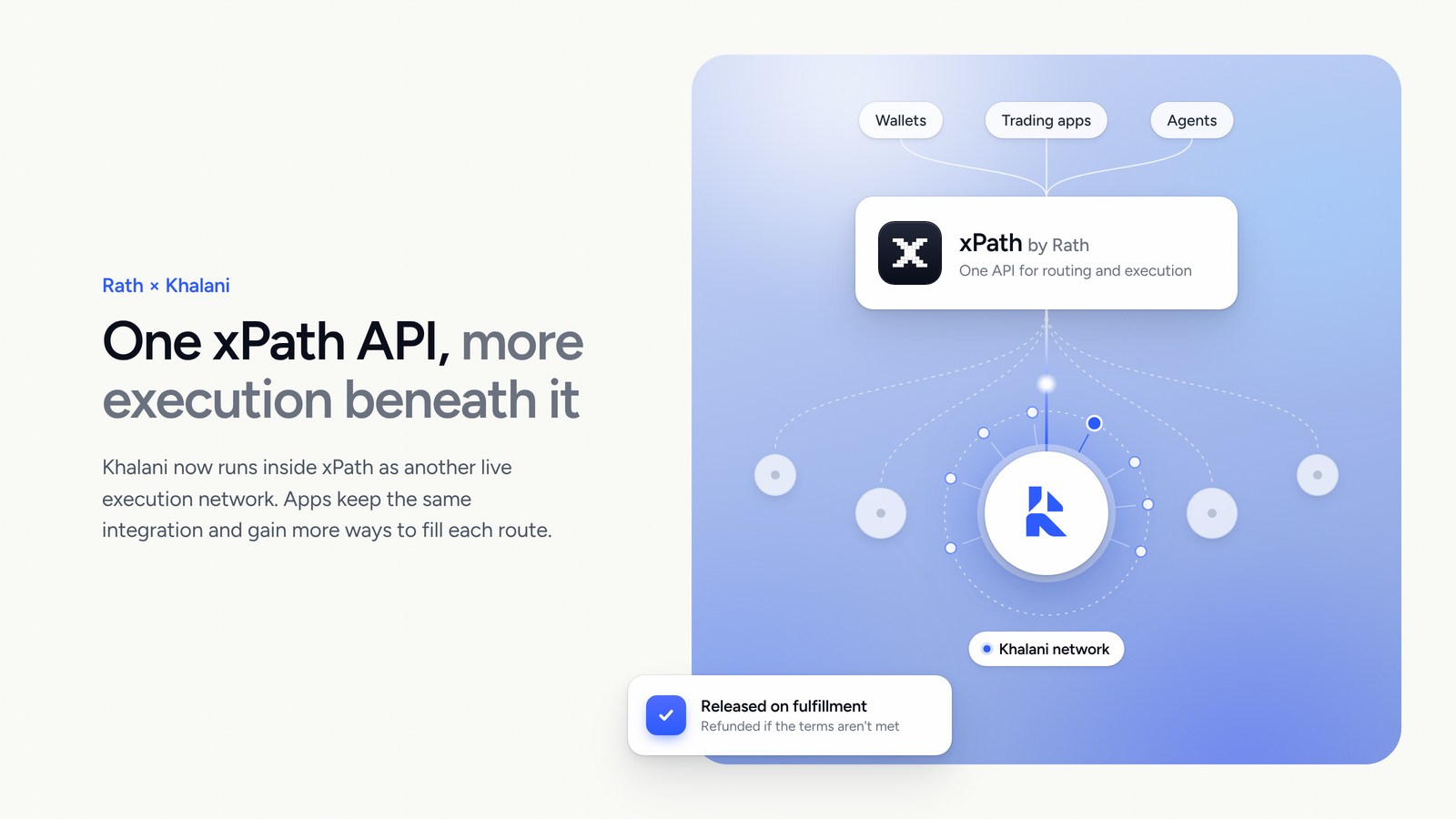
Khalani is now live as a solver network within xPath, adding Khalani’s competitive source of crosschain execution for applications moving assets through Rath’s routing and execution layer. The integration expands the liquidity and execution options xPath can evaluate across fragmented corridors and introduces additional capacity for larger or more complex requests when a single route or provider is constraining.
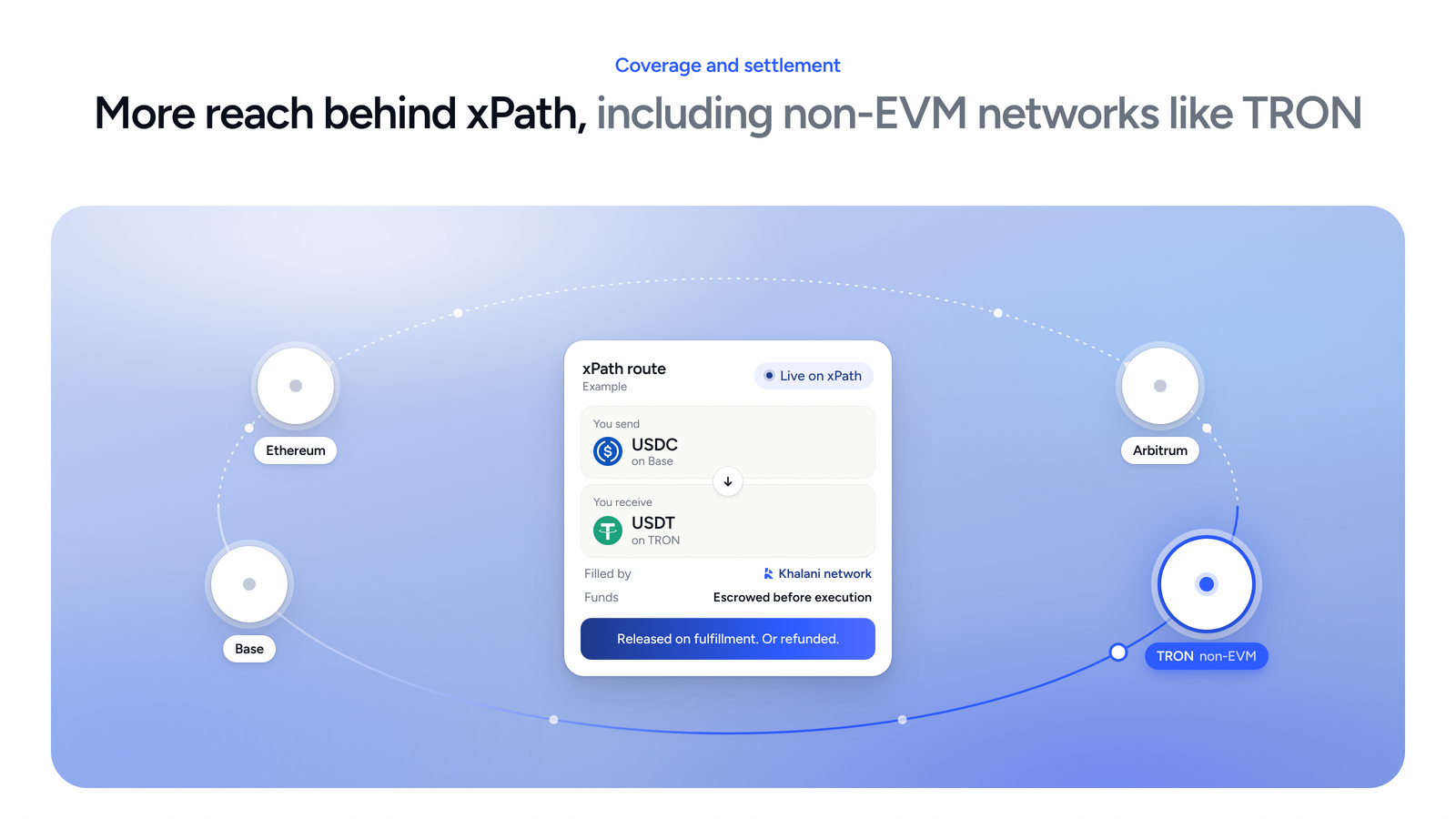
Khalani’s multi-chain execution network also broadens the available coverage surface. Where the requested route and asset are supported, the integration can extend execution reach to non-EVM networks such as Tron, alongside Khalani’s broader crosschain network.
This is not simply more routes. It is a larger competitive execution surface for the applications building on Rath: more solver optionality, broader reachable liquidity, and more potential ways to serve transactions that are difficult to fulfill through one provider or one path.
Rath: Yield. Routing. Execution.
Rath builds production-grade DeFi rails for teams building category-defining products. Its product stack spans yield, routing, and execution.
xPath is Rath’s unified routing and execution layer for onchain asset movement. Through one API, applications can access same-chain swaps, crosschain swaps and bridging, route discovery, transaction-ready calldata, token discovery, and gasless execution flows. Instead of stitching together separate quote engines, bridges, DEX routes, token catalogs, and transaction builders, developers integrate one surface that plans the route and returns the information needed to execute it.
Tachyon provides Rath’s high-speed execution infrastructure across chains. Together, xPath and Tachyon give developers the routing and execution rails needed to build fast, neutral, and transparent crosschain experiences without operating every underlying provider and system themselves.
xPath was designed to compose the best available execution infrastructure. The Khalani integration extends that design with another competitive solver network operating inside the routing surface.
Coverage and capacity define execution quality
Execution quality is not only a question of finding a path between two assets. It is a question of whether the path has the coverage, available liquidity, and competing execution sources to serve the requested transaction.
That becomes more important when the order is larger, the corridor is fragmented, assets are long-tail, or liquidity is uneven across chains. A routing surface may return a path, but a path without viable execution capacity can still result in poor pricing, delayed completion, partial execution, or no executable route at the requested size.
For wallets, trading applications, consumer products, and agents, this complexity should remain invisible. Users expect the product to return a viable route and clear execution terms, not send them into a manual search across bridges, liquidity sources, and execution venues.
The answer is not merely more integrations. It is more qualified execution options competing under the routing layer, with route-specific availability evaluated at quote time.
What the live integration delivers
Broader crosschain coverage
Khalani adds a solver network with coverage across EVM and non-EVM networks. Where a requested xPath route and asset are supported, that gives xPath an additional execution path into fragmented liquidity environments, including non-EVM ecosystems such as Tron.
More execution capacity for larger and more complex orders
Larger or more complex orders can exceed the practical capacity of a single provider, route, or inventory source. Khalani introduces another competitive execution network for xPath to consider, widening the pool of potential solvers and liquidity sources available for a request.
For a given transaction, availability, price, and fill outcome remain subject to the requested route, live liquidity, execution terms, and quote conditions. It gives xPath more potential execution options when order size, corridor complexity, or liquidity fragmentation matters.
Stronger solver competition
Khalani’s qualified solvers compete to fulfill requests under the network’s execution and settlement rules. When a Khalani route is available and competitive, it can be considered alongside other execution paths inside xPath.
More available execution options create productive pressure on the network beneath the routing layer: applications can benefit from a broader set of potential quotes and fulfillment paths without adding another integration to their own stack.
Conditional settlement and lifecycle handling
Khalani’s settlement kernel is designed around escrow before execution, conditional release on fulfillment, and refund handling when the specified conditions are not met. That gives applications a structured settlement and recovery model beneath the execution path rather than a best-effort handoff across disconnected services.
Better handling of fragmented corridors
Khalani coordinates solver activity across open transactions and can optimize execution across fragmented or asymmetric liquidity environments. This is especially relevant for crosschain corridors, long-tail asset pairs, and multi-step routes where a single direct path is not always the strongest execution option.
For developers building on xPath, the integration does not create another implementation project. The same xPath API remains the developer surface. Khalani operates beneath it as an additional live solver network that can contribute execution options when the route is supported.
A natural alignment
Rath and Khalani share a conviction that onchain execution should be open, competitive, and composable.
Rath applies that principle at the routing layer, connecting applications to the available liquidity and execution systems needed to move assets across chains. Khalani applies it to solver competition and transaction execution, enabling qualified solvers to compete to fulfill defined outcomes under explicit settlement rules.
The systems compose because each preserves the product experience above it. Applications continue to use xPath as their unified routing and execution surface. Khalani expands the competitive execution network available beneath it.
Looking ahead
The Rath–Khalani integration is live. As xPath broadens its route and network coverage, and as Khalani expands its solver depth and specialization, applications building on Rath can draw from a wider set of execution options for crosschain movement.
That matters for the next generation of wallets, consumer applications, trading systems, and agent workflows. These products need execution that remains simple at the interface while becoming more capable beneath it: broader coverage, more optionality, and more capacity to handle difficult transactions as demand grows.
━
About Rath
Rath provides DeFi infrastructure for teams building category-defining products. Its product stack spans yield, routing, and execution: xPath for unified routing and execution across swaps, bridges, and gasless flows; Tachyon for high-speed transaction execution; and Rath APIs for onchain yield. Learn more at rath.fi.
About Khalani
Khalani enables applications to source and settle crosschain execution through competitive solver networks, with conditional execution, lifecycle visibility, recovery logic, and reconciliation support built into the transaction flow. Learn more at khalani.network.